
San Rafael, CA · Garage Door Service
Why So Many San Rafael Garages Feel Like the Outdoors
Most San Rafael houses date to 1938-1996, years before any code required insulated garage doors. Here's what that uninsulated panel is actually costing you.
- Repairs & new doors
- Springs & openers
- Serving 5 nearby communities
The Problem
San Rafael's housing stock mostly went up between 1938 and 1996, with the median build year landing around 1960. That matters for one reason: no building code anywhere required insulated garage doors back then. The door that came with your house, or the one a previous owner swapped in during a remodel decades ago, is almost certainly a single layer of steel or a slab of wood with nothing behind it. No foam core, no thermal break, no R-value to speak of.
Across the 38 or so named areas that make up this part of Marin, the pattern repeats. Houses built in that same mid-century wave got the same door technology, because that's what every manufacturer was making at the time. It's not a defect specific to your garage. It's just what a 1960-built house came with, and most of them never got upgraded because the door still opens and closes fine.
The issue isn't that these doors fail outright. It's that they were never built to do the job homeowners now expect of them - keeping a garage dry, quiet, and not actively leaking conditioned air into or out of the house.
What Local Conditions Do
San Rafael sits in a mild temperate band, which is actually the reason a lot of these old doors have lasted as long as they have. You're not dealing with the freeze-thaw cycling that cracks panels and splits seams in colder climates, and you're not getting the kind of extreme heat that warps steel skins. That's the good news.
The slower problem is moisture and daily temperature swing, repeated over fifty or sixty years. An uninsulated steel door has nothing to stop condensation from forming on the inside face when the air outside cools faster than the garage interior. Over decades that moisture finds every seam, every fastener point, every spot where the galvanizing is thin, and it rusts from the inside out - often invisible until the bottom panel is soft. Wood doors from the same era swell and shrink with the seasons since there's no vapor barrier behind them, which is why so many from the 1960s and 70s have a visible cup or twist in at least one panel by now.
Mild climate doesn't mean no wear. It means the wear is slow, cumulative, and easy to miss until the door is heavier to lift than it used to be.
What to Check
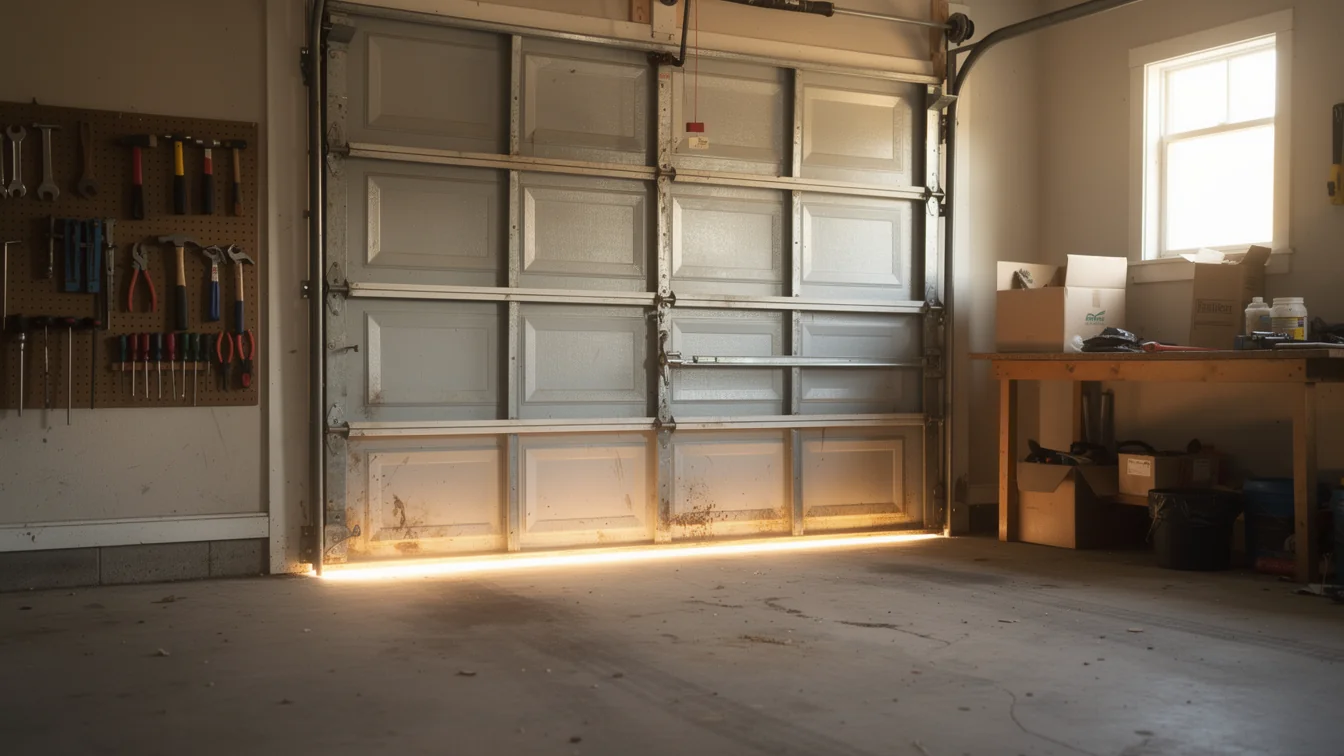
Start by looking at the back of the door panel, not the front. If you can see bare steel or bare wood with nothing laminated or sprayed to the inside face, that door has no insulation layer at all - consistent with the pre-1996 build era common across this area.
Next, run your hand along the bottom seal and the side tracks on a cool morning. If you feel outside air moving through, the weatherstripping has likely outlived its useful life, which happens faster on original hardware that's never been replaced.
Check panel weight. An uninsulated door is noticeably lighter than an insulated one, which means the spring tension set up decades ago may now be slightly mismatched if any hardware has been swapped piecemeal over the years - a common situation in houses this old where one panel or one spring got replaced without touching the rest.
Look for rust lines at the bottom two inches of each panel, especially near the corners. That's where decades of condensation collects first on an uninsulated steel door, and it's usually a few years ahead of where it's visible from the outside.
The Common Mistake
The mistake we see most is homeowners assuming the fix is always a full door replacement. Sometimes it is - if the panels are rusted through or the wood has delaminated, no amount of weatherstripping saves it. But a lot of 1960s and 70s doors in this area are structurally fine. The steel is solid, the hardware still tracks true, and the only real problem is that the door was never insulated and the perimeter seal has worn out. In that case, a new bottom seal, side seals, and in some cases a retrofit insulation kit solves most of the draft and noise complaint for a fraction of a replacement cost.
The flip side mistake is retrofitting insulation onto a door whose panels are already failing. Adding a foam kit to a door with rust-weakened seams just adds weight the springs and opener weren't set up for, and speeds up the failure. We won't sell an insulation retrofit on a door that's past the point where it's worth doing - that's a case where replacement is the honest answer, even though it costs more upfront.
Frequently asked questions
Is my garage door too old to insulate, or should I just replace it?
Depends on the panel condition, not the age alone. If the steel or wood is solid and the only issue is draft and noise, a retrofit insulation kit and new weatherstripping usually does the job. If you're seeing rust-through, delamination, or sag, insulating a failing panel just adds weight the hardware wasn't set up for - that's a replacement situation.
Why does my garage door sweat on cool mornings?
An uninsulated steel door has nothing between the cold outside face and the warmer garage air, so condensation forms on the inside skin. It's common on original doors from the 1960s and 70s build era in this area, and over enough years that moisture is what causes the rust lines you see near the bottom panel.
Does San Rafael's mild climate mean I don't need to worry about this?
It means you're spared the freeze-thaw cracking and extreme heat warping that harsher climates cause. But mild and humid still means decades of slow condensation cycling, which is why panels from houses built before 1996 often show rust or warping even without dramatic temperature swings.
Related garage door services in San Rafael
More garage door guides
Book garage door service in San Rafael
Call now or request a quote - tell us what the door is doing and where you are.