
San Rafael, CA · Garage Door Service
Why a Spring Breaks on the One Cold Morning San Rafael Gets
San Rafael's mild winters still drop into the 30s some nights. Here's why older torsion springs on 1960s-era homes let go on those mornings, and what to check first.
- Repairs & new doors
- Springs & openers
- Serving 5 nearby communities
The Problem
San Rafael doesn't get hard winters. The climate here runs mild temperate, so most homeowners never think about their garage door spring and temperature in the same sentence. Then one January night drops into the high 30s, and the next morning the door won't budge, or it slams down the last two feet with a bang.
That's not a coincidence of bad luck. A torsion spring is a coiled piece of steel under constant tension, and steel contracts slightly as it cools. On a spring that's already fatigued from years of cycling, that small contraction is enough to be the last straw. In a place with real winters, people expect this and plan for it. In San Rafael, where most days stay comfortable year-round, a cold snap catches people off guard precisely because it's rare.
The houses most likely to see this are the ones built when this area went up fastest. Housing stock here runs 1938 to 1996 with a median build year around 1960, and most of that is concentrated in the 1960s and 70s wave across the named neighborhoods and unincorporated areas nearby. A spring installed with an original 1960s or 70s door, or even a straightforward one-for-one replacement since, is old enough now that age and a cold morning can line up.
What Local Conditions Do
Mild temperate doesn't mean no temperature swing. It means the swing is smaller than other parts of the country, but it still happens, and it happens on top of decades of daily cycling that the spring has already absorbed. A spring doesn't fail because of one cold night. It fails because one cold night removes the last bit of margin from a coil that was already near the end of its rated cycle life.
This matters more in houses from the 1960s and 70s stock that makes up most of the area, because those garage doors have had the most years to rack up cycles. A door opened and closed twice a day for fifty-plus years is well past the point where the original spring, or an undersized replacement, has much life left. Add a cold morning and the coil that was holding on finally lets go.
It isn't a weather event in the way a hailstorm or a hard freeze is. It's a steel fatigue problem that a mild cold morning happens to expose.
What to Check
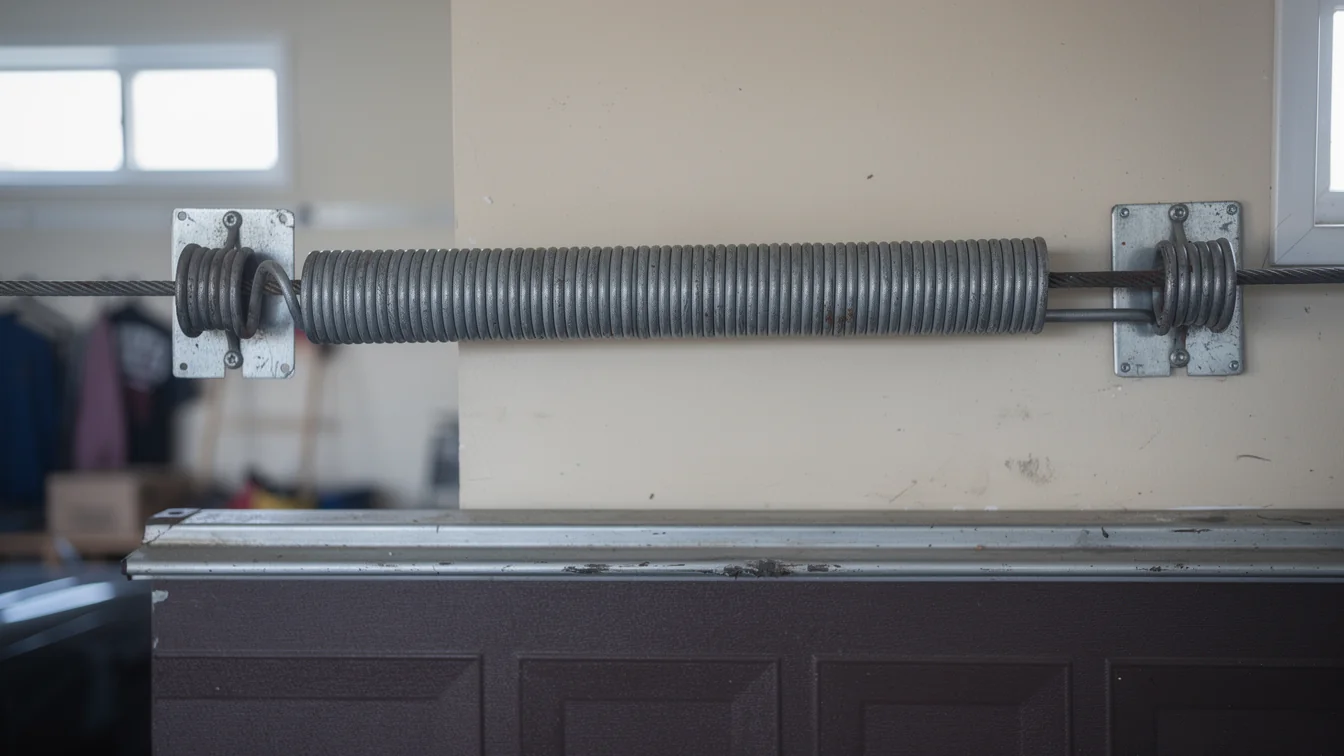
If your door feels heavy, sits crooked when it's halfway up, or makes a loud bang first thing on a cold morning, look at the spring before you touch anything else. On a torsion spring above the door, a visible gap in the coil means it's already broken and the door is not safe to run on the opener alone.
If the door has been getting harder to lift by hand over the past few months, especially noticeable on colder mornings, that's a spring losing tension, not an opener problem. Don't keep running the opener through it. Pushing a worn-out spring past the point it's telling you to stop is how a cable snaps or the door comes off track, and both of those cost more to fix than the spring would have.
Check the age of the door and spring against your home's build date if you know it. A house from the original 1960s or 70s wave that's never had the spring replaced is carrying fifty-plus years of cycles on original or early-replacement hardware.
The Common Mistake
The mistake we see most is waiting for a hot day to deal with a cold-weather spring problem, because by July the door's working fine again and it's easy to forget. The spring that struggled in January didn't fix itself. It's back to its normal tension in warmer weather, but the fatigue that caused the failure is still there, and it'll find the next cold morning just as fast.
The other mistake is assuming a mild climate means spring wear isn't a thing here the way it is elsewhere. It is. It just shows up less often and surprises people more when it does, because nobody's expecting a garage door problem triggered by weather in a place that rarely drops below freezing.
One honest limitation: we can't tell you how many cycles are left in a spring just by looking at it from across the garage. If it's original to a 1960s or 70s house and it's never been replaced, the safe assumption is that it's near the end, cold morning or not.
Frequently asked questions
Why did my spring break on a cold morning if San Rafael doesn't really get cold?
Steel contracts slightly as it cools, and that small change is enough to push a spring that's already worn past its breaking point. San Rafael's mild climate means fewer cold mornings, but the ones you get still land the same way on an old coil.
My house was built in the 1960s. Is the spring original?
It's possible. A lot of the housing in this area dates from that same 1960s-70s building wave, and if the spring has never been replaced, it's carrying decades of daily cycles. That age is a bigger factor than any single cold night.
Is it safe to keep opening the door if the spring looks stretched or uneven?
No. Run the opener through a weak or visibly uneven spring and you risk a snapped cable or a door that jumps off its track, which is a bigger repair than the spring alone. If it looks off, stop using the opener until it's checked.
Related garage door services in San Rafael
More garage door guides
Book garage door service in San Rafael
Call now or request a quote - tell us what the door is doing and where you are.